RSS Feed

Article Image Alt Text

Jim Brown

Attacking crime in Louisiana

President Trump is suggesting that the national guard could be used in additional American cities besides the nation’s capital, and has included New Orleans on his list. I have no problem with this, but we need to do a lot more on our own here in Louisiana.
There is a wave of irrational violence in cities all over the state. Baton Rouge and New Orleans have become war zones. Shreveport and Monroe have some of the highest murder rates in the nation. There were 923 violent crimes reported for every 100,000 people in Shreveport last year, compared to 399 incidents per 100,000 nationwide.
What can be done to stop the surge of violence in the Bayou State? “Why not form a government-community agency of professionals whose job it will be to build a comprehensive road map to safety,” suggest columns in the state’s two largest newspapers. But we have formed committees and studied the crime problem for years with nothing concrete to show for it. The criminal violence continues.
Some suggest a variety of social and economic incentives that need to be put into place. But such programs will require not only a massive financial influx of taxpayer dollars and will also take years to implement. We need effective programs now.
So, what to do? Here are my suggestions for this Governor and legislators. It’s a similar plan to what I suggested back in 1987 when I ran for the state’s highest office. First, allocate in the state’s budget 100 million dollars for grants to cities that crack down on crime. I mean really crack down.
“Oh, but the funds are not available,” legislators will protest. Hey, Louisiana is flush with funds, and the current budget is loaded with pet projects packed in by legislators in Baton Rouge. What’s more important, a rock ‘n’ roll museum in New Orleans, funds for more marijuana growing and dispensing agencies, and legal fees for insider reapportionment help? Or dollars to stop citizens from being slaughtered in their own homes?
Here is what should be done.
Require a strong “no broken windows” program. That means tearing down abandoned buildings, requiring grass to be mowed (no tall weeds), see that graffiti is painted over, and no trash allowed to pile up. Put a lien on any property that fails to comply. And levy serious fines on those property owners who failed to conform. Also improve and brighten streetlights in these high crime areas. Blighted areas and darkened neighborhoods have proven to be a cesspool for crime.
Stop and Frisk? Some say it’s unconstitutional to profile. But we do it all the time. Doesn’t the TSA profile anyone that tries to board a plane? If a crime has been committed supposedly by a teenage male, and someone of that description is in the neighborhood, he should be stopped, questioned, and searched for a weapon. I would have no problem being detained and searched if I was in a high crime area, and the police were in pursuit. Hey, you may have to give a little if it means being a lot safer.
Cities and local communities should develop hotspots or “criminal grids” that indicate the most violent concentrated areas. Then direct a high visible law enforcement presence in these areas where we know more violent crime takes place.
Mandatory curfews for any child under 16 years old. Mama said it best. Nothing good happens after midnight. Why allow some 14-year-old to roam the streets at 2 o’clock in the morning? Without a compelling reason to be up and about, these kids should be home asleep.
Local communities that Institute such programs listed above should benefit and get grant money. For those who don’t, shame on them. It’s time to quit talking about preventing crime, and actually taking a bite out of crime. There are other proposals, and this is just the beginning. But citizens like me are sick and tired of looking over their shoulder, and constantly worrying about our family safety. These suggestions are no-brainers. We are looking towards the Governor and our legislators to take action. It should be done now.
Peace and Justice
Jim Brown
Jim Brown’s syndicated column appears each week in numerous newspapers throughout the nation and on websites worldwide. Â You can read all his past columns and see continuing updates at http://www.jimbrownla.com.

New survey reveals staggering double digit declines in favorability for Democrats among swing voters since 2017

Democrat favorability has plunged among swing voters since 2017, the year before the 2018 midterm election cycle when Democrats won a net gain of 41 seats in the House of Representatives, taking back control of the House for the first time in eight years. Democrats are hoping to repeat that strategy in 2026, but the political landscape has changed — a lot.
While Congressional Democrats cling to a narrow lead of 3.6 percentage points in the latest generic Congressional ballot average, there is reason to believe that edge may not materialize in the election next year, considering how rock-bottom the party’s favorability is among swing voters.
Democrats are sitting at a historic low in favorability among the general public, and their numbers have absolutely cratered compared to where they sat in 2017 among swing voters, notably, young, independent, and Hispanic voters. College-educated voters, a group which supported Democrats by double digits in 2018, are also increasingly critical of the Democrat Party.
According to the latest YouGov survey, Democrats in Sep. of 2017, the Autumn before the 2018 midterm cycle sat at a 47.6 percent favorable rating of voters under age 30 y, while slightly fewer, 41.2 percent, held a negative view. The Democrat Party’s net favorable rating was 6.4 points in Sep. 2017. That positive view of the party has evaporated and reversed over the past eight years, pushing Democrats into territory the party has never faced with young people.
The latest YouGov survey from Aug. 24 shows Democrats sitting at a net favorable rating of -35.1 points, with over two-thirds (64.8 percent) of young voters holding an unfavorable view of the party, while 29.7 percent hold a positive view. This amounts to a staggering 41.5 percentage point decline in net favorability for Democrats over just eight years.
Hispanic favorability for Democrats has also declined substantially since 2017, but not to the degree that it has for young voters. Democrats sat at a net favorability of 8.8 points in Sep. 2017, with 50.1 percent of Hispanics holding a favorable view of the party while 41.3 percent held an unfavorable view. Those numbers have reversed today, with Democrats sitting at a net approval rating of -11.1 points. 51.2 percent of Hispanics now have an unfavorable view of the Democrat Party, and 40.1 percent have a favorable view. This amounts to a 19.9 percentage-point decline in net favorability for Democrats since Sep. 2017.
The Democrat Party has also suffered a significant blow among Black voters, a group which overwhelmingly supports Democrats, but is showing one of the largest declines in support compared to 2017. In Sep. 2017, the Democrat Party enjoyed a net approval rating of 51.5 percentage points, with a full 71.5 of Black voters holding a favorable view of the party while 20 percent held an unfavorable view. Today, the Democratic Party sits at a net approval rating of 24.2 percentage points, with less than two-thirds (60 percent) of Black voters approving of the party and 35.8 percent disapproving. This amounts to a 27.3 percentage-point plunge in net approval for Democrats.
College educated voters, a group which voted for Democrats by a 23-point margin in the 2018 midterms, are also moving away from the Democratic Party at an accelerated pace. In the fall of 2017, college educated voters were lukewarm about the Democratic Party and offered the party a net approval rating of -13.2 percentage points. It wasn’t a high approval rating, but it was enough to lock in the college educated in the 2018 midterms. That may not be the case in 2026. Democrats currently sit at a net approval rating of -28.5 points, with 62.8 percent of college-educated voters disapproving of the party while 34.3 percent approve.
These bleak favorability ratings are stark when measured against the Democratic Party’s favorability among swing voters just eight years ago. The steep, double-digit declines in favorability for a party that has been labeled “weak and woke” by voters is not a surprise. What is a surprise, is that the Democratic Party has the audacity to criticize conservatives for implementing real solutions to inflation, joblessness, crime, and the border, and then expects these voters to line up to support them at the ballot box.

Manzanita Miller is the senior political analyst at Americans for Limited Government Foundation.

D.C. Mayor Bowser says Washington, D.C. carjackings down 87 percent: ‘We greatly appreciate the surge of officers’

“The federal surge has had a significant increase in crime in Washington DC. and we greatly appreciate the surge of officers that enhance … what MPD has been able to do… in this city.”
That was Washington, D.C. Democratic Mayor Muriel Bowser on Aug. 28 praised, of all things, President Donald Trump’s activation of the National Guard and declaration of a crime emergency in the city.
The reason? Crime is going down, with Bowser stating that carjackings alone are down 87 percent from this time last year in the 20 days since Trump declared the emergency: “We’ve highlighted the area in yellow that shows the impact of the surge of FBI, DEA, ATF, and park and capitol police and other federal agencies in the district. And the federal crime the federal surge has had a significant increase on crime in Washington, D.C. and we greatly appreciate the surge of officers that enhance um what MPD has been able to do uh in this city. The most uh significant thing that we are highlighting today is the area of crime that was most troubling for us in 2023.”
It turns out the Metropolitan Police Department of the District of Columbia is understaffed and overworked with many officers working overtime, per Bowser: “And so we continue to do that work um to stabilize and to increase our force strength to what we believe is um where we need to be 3,800 to 4,000 officers… [Y]you've heard me say and I will continue to say we need at least 500 new officers — to hire 500 new officers over the course of the next several years to have the number of officers that we need and to decrease the amount of overtime that we use.”
Of course, the fact of more law enforcement on the streets reducing crime is not actually that surprising. To address the violent crime wave of the 1980s, surging police force levels throughout the 1990s and early 2000s were effective at reducing overall violent crime rates, as one would expect, an Americans for Limited Government study of Federal Bureau of Investigation (FBI) Crime Data Explorer data from 1985 to 2021 shows, with greater numbers of cops correlating with less violent crimes reported and fewer officers leading to more violent crimes reported.
Power abhors a vacuum. That is why the Defund the Police movement after the death of George Floyd in Minneapolis, Minn. in 2020 was so dangerous to the lives and property of urban residents throughout the country.
In Minnesota, as police forces were reduced statewide in 2020 by 2.7 percent, violent crime shot up by a whopping 16.8 percent. Similarly, as police forces surged in the 1990s, violent crime dropped dramatically.
In Maryland, the opposite happened. When former Republican Gov. Larry Hogan came into power in 2015, he immediately surged police force levels by 10.1 percent and then kept them steady throughout his administration, with further increases in 2018 and 2019. As a result, violent crimes dropped by 6.7 percent in 2018, 3.2 percent in 2019 and 11.9 percent in 2020.
In Oregon, similar increases in law enforcement personnel throughout the 1990s led to overall drops in violent crimes reported. A drop in personnel in the early 2000s led to an uptick, followed by another surge that led to more decreases in violent crimes. In 2015, as violent crime began increasing, by 2017 police forces were increased by 8.1 percent and kept steady until finally, in 2020, violent crime dropped.
In Washington State, much the same. Surges of police forces in the 1990s and early 2000s were effective at reducing reported violent crimes. A similar uptick in violent crimes began in 2014, and eventually increasing police force levels from 2016 to 2018 led to ultimate drops in violent crimes committed in 2019 and 2020 by 3.8 percent and 3.2 percent.
In New York State, surging police forces beginning in the 1980s and 1990s also led to dramatic drops in violent crimes reported including during Republican Mayor Rudy Giuliani’s tenure in office that ended in 2001. Afterward, decreases in police force levels by 6.5 percent in 2002, 10.3 percent in 2003 and 1.6 percent in 2005 led to the eventual 0.9 percent increase in reported violent crimes in 2005, whereas a 19.2 percent surge of forces in 2004 reduced violent crime by 5.4 percent. Drops in the force levels in the 2010s also led to upticks in reported violent crimes, followed by brief surges that brought the numbers down again.
Similar experiences can be found in cities throughout the country. It’s counterintuitive, but the more police there are, the less likely you are to call the police and report a crime — because fewer crimes will be committed. While defunding and decreasing police presence makes it more likely you will have to encounter the police.
And the numbers seen now in D.C. are undeniable, with violent crime being eliminated in Washington, D.C. and also the National Guard deployment in Los Angeles assisting in putting down the riots there in June.
Now, President Donald Trump is considering other potential National Guard deployments, including in Chicago, Ill, where there were 573 homicides in 2024. As well he should. As will be expected, the Chicago Democratic Mayor Brandon Johnson will complain, as he already is, but the same thing will happen and the violent crimes would drop. Johnson and the city of Chicago can thank Trump later.

Robert Romano is the Executive Director of Americans for Limited Government Foundation.

Article Image Alt Text

Jim Bradshaw

When the prairies were isolated, and scary

He crossed the Sabine in 1852 and wandered through what is now Calcasieu Parish for several months, “ending with a visit to Lake Charles and its three Catholic families.” He said in his autobiography that he was the first priest to come to the area in at least 20 years. (The Reminiscences of a Texas Missionary, San Antonio, 1899)
“After crossing the Sabine River, I visited Calcasieu Parish, an immense district … [where] crossing bayous and bottoms, marshes and bogs … and getting lost on the pathless prairies were of frequent occurrence,” he wrote. There were no bridges in those days, and the bayous were “numerous and deep.” His method of crossing them was to “hold my horse by the tail with one hand and paddle with the other.”
Somewhere in the Calcasieu area he visited a small settlement of Caranchua Indians. He baptized 11 children there, when “a Creole gentlemen who spoke the dialect of the tribe stood as sponsor.” He also baptized the daughter of the chief, who was then in her fifties and came “a considerable distance” with her two children, who were also baptized.
The chief, “a stout man of 85, who knew a little broken English,” told the priest that “a long time ago he was owner of all the country around.” That was when his tribe was “plenty, plenty.” The old chief was also the doctor for his settlement, with a “pharmacy consisting of herbs, flowers, and roots of the forest of his kingdom.”
Father Parisot was heading back toward Texas when he had a chance encounter scary enough to make him say what he thought might be his final prayers.
“Turning toward the Sabine River, I met a crowd of Indians in the woods who nearly frightened the life out of me,” he wrote. “Were they gentle or wild? I said my Act of Contrition, and when they drew near, I tried to look pleasant and bade them good evening. They muttered a few words and passed by. My fear abated and my heart beat more regularly.”
He may have been unduly alarmed because he was a newcomer to the “wild west.” He left France in March 1852 as part of a group of “six Oblate Fathers and one Lay Brother, accompanied by four Nuns of the Incarnate Word, two Ursuline Sisters, four Brothers of Mary, and eighteen seminarians.” They made the two-month voyage to New Orleans and then to Galveston in response to a plea for missionaries by Jean-Marie Odin, newly appointed bishop in the Galveston diocese, which then included all of Texas. (Odin was later named Archbishop of New Orleans.)
Father Parisot made at least two more trips to Calcasieu Parish. On the second trip he was helped by “a French gentleman named Pujo” who was about to sail down the Calcasieu in a small boat. The priest went with him and “baptized on both sides of the river while the captain sold his goods.”
This was almost certainly Paul Rose Pujo, who came to Louisiana from France and who moved from New Orleans in the 1840s to Rose Bluff, a little settlement on the Calcasieu, and who later opened a store and saloon on the Lake Charles lakefront at the foot of Pujo Street, which is named for him.
Father Andre Borias came with Father Parisot on his third trip to Calcasieu, probably in 1854. Both priests were then stationed in Galveston, but Father Borias later became pastor at Beaumont and regularly visited the Calcasieu area from there. The registers of the Galveston Diocese show 129 baptisms were recorded in Calcasieu Parish during those missionary years.
You can contact Jim Bradshaw at jimbradshaw4321@gmail.com or P.O. Box 1121, Washington LA 70589.

Article Image Alt Text

Chocolate, Strawberry, Lemon

Baking is on my mind lately, and I really miss my baking station has at the far house. It has an electric oven under the gas cooktop and a separate electric oven around the corner from the range.
Real chefs cook with gas and bake in electric ovens. I was in bakers heaven. That duel fuel range is amazing.

CHOCOLATE CHEESE CAKE

No cream cheese
No sour cream
What Boo worries about if dessert is round

INGREDIENTS

-1 1/3 cups high protein 4% cottage cheese, brought to room temperature
-4 large eggs, room temperature
-1 cup dark chocolate chips, 60% cocoa
How’s that for counting ingredients?

MISE EN PLACE

-Preheat oven to 350 degrees.
-Grease the interior of a 6” round pan.
Important: Be sure to use a one-piece pan and not a springform. Try to use one that is 3” deep.
-Line bottom of pan with a parchment paper round and line the sides with strips of parchment paper.
-Add cottage cheese and eggs to a blender.
-Blend until cottage cheese is smooth and there are no egg streaks. After the cottage cheese is smooth and mixed with chocolate, it takes on that flavor.
Boo hasn’t discovered the secret yet.
-Add chocolate chips to a microwave-safe bowl.
-Heat in 30 second intervals.
-Stir with a spatula between each 30 seconds until chocolate is smooth.
-Let the chocolate cool slightly, about 5 minutes.
-Add melted chocolate to the blender.
-Blend until you have a smooth batter.
-Scrape down the sides of the blender as needed to get everything blended.
-Transfer the batter to baking pan.
-Place the cake pan in a slightly larger baking pan. A 9” square pan will work.
-Fill the outer pan with water at room temperature until water reaches halfway up, creating a water bath.
-Bake for about 30-35 minutes, or until center is slightly jiggly. It may take as long as 45 minutes, so just watch for a “giggly” center. The cake should also be pulled away from the cake pan.
-Remove cake from oven and out of water. From experience, I can tell you that managing the hot water is the only con about using a water bath, and caution is required. Google told me Tuesday that water bath is also known as “Bain Marie.” What a great French phrase to add to our baking vernacular.
-Allow it to cool; it will deflate a little.
-Gently loosen the sides with a thin spatula or table knife.
-Carefully flip the cake pan upside down into a plate.
-Flip the again onto a cake plate for it to be right side up until totally cooked.
-The cake is delicious as is, but the topping options are unlimited. Look up “cheese cake toppings” on Google for many choices. The chocolate gravy would be perfect.
-This crustless cheese cake is a firmer than a traditional cheesecake. Still very creamy and not quite as sweet.
-For a sweeter cake, add one of those toppings. The sky’s the limit.

CHOCOLATE GRAVY

Memories of my grandmother

-3/4 cup sugar, more to taste
-1/4 cup flour
-1/4 cup cocoa powder
-2 cups hot milk
-1 egg
-2 tbsp butter
-1 tsp vanilla extract

MISE EN PLACE

-Mix sugar, flour, cocoa powder in a saucepan.
-Stir in 1/2 cup milk
-Add egg.
-Stir in remaining milk.
-Cook over medium heat until thick, about 3 to 5 minutes
-Add butter and vanilla extract.
Advice
-Stay by the stove. Once the gravy gets warm, it thickens quickly.
-Try a flat whisk as it helps with scraping bottom and sides of pan. A flat whisk can be ordered from Amazon.
-Don’t panic if you have clumps. Use a sieve to remove any large pieces.
-Add 1/4 tsp salt to bring out the chocolate flavor. Do this when adding the vanilla and butter.
-Store leftovers in a resealable container in the fridge. Cover the gravy directly with plastic wrap before closing lid to avoid the “skin” that can form on top.
-This gravy makes a delicious chocolate sandwich.
-Spoon some over a slice of pound cake.
-Use it on top of pancakes.
-Dip saltine crackers for that delicious salty/sweet flavor. Potato chips ramp up the flavor tremendously.

My MomMom Chalice made amazing chocolate bread with “gravy” similar to this. She cooked it a little longer, and dipped half slices of bread directly in the pot. They were laid in single layers to cool enough to eat them hand picked right off the platter. I have tried many times to replicate her recipe with no luck. My friends, Pam and Marla, can make a batch while I am watching. Delicious, but not exactly like MomMom’s. I still can’t get the trick but will try again and again.

STRAWBERRY SQUARES
Basically brownies made with strawberries instead of chocolate

INGREDIENTS

-1 (15.5 oz) box strawberry cake mix
-1/2 cup unsalted butter, melted
-2 large eggs, room temperature
-2 tsp vanilla extract
-3 strawberries, chopped
-1 1/2 cups confectioners sugar, or more if needed
-1/4 tsp kosher salt

MISE EN PLACE

-Preheat oven to 350 degrees.
-Lightly grease an 11x7” baking dish.
-Mix cake mix, melted butter, eggs, and 1 tsp vanilla extract in a bowl.
-Stir until well blended.
-Spread mixture into an even layer in the prepared baking dish.
-Bake until a toothpick inserted in center comes out clean, 16 to 18 minutes.
-Allow brownies to cool in the pan for 20 minutes.
-Meanwhile, puree strawberries and remaining teaspoon of vanilla with a an immersion blender or in a blender.
-Stir strawberry mixture into confectioners sugar until smooth.
-Add extra as necessary to reach consistency of a glaze.
-Add salt and stir.
-Spread strawberry glaze evenly over the cooled strawberry cake.
-Cut into 12 squares and enjoy.
-Refrigerate leftovers. If you have any.

LEMON SHEET CAKE

Back to the 60’s
Jell-O shines again
Perfect for lemon lovers.

INGREDIENTS

-1 (3 oz) package lemon Jell-O
-1 1/3 cups boiling water
1 box lemon cake mix
-3 large eggs
-2/3 cup vegetable oil
-1 1/2 cups powdered sugar
-1/4 cup fresh lemon juice

MISE EN PLACE.

-Preheat oven to 350 degrees.
-Grease and flour 9x13” baking pan.
-Stir lemon Jell-O into boiling water in a large bowl.
-Let cool to room temperature, about 30 minutes.
-When Jell-O is at room temp, add cake mix, eggs, and vegetable oil, and mix with an electric mixer on medium speed for 2 minutes.
-Spread batter evenly in the prepared baking pan.
-Bake until a toothpick inserted into the cake comes out clean, 30/35 minutes.
-While cake is baking, whisk together powdered sugar and lemon juice in a small bowl.
-Remove the baked cake from the pan.
-Using a chopstick or straw, poke holes about 1 inch apart.
-Drizzle glaze over the cake.
-Spread evenly.
-Let cake cool completely about 1 hour.

Bake and love the baking. You will love the cakes!
We’re off to the east coast today, a golfing week with Saturday night in Clemson. Good luck to the tigers, LSU TIgers! There’s golf in Augusta and Pinehurst. So I will be spending a lot of wonderful alone time. I’m hoping to find some new, delicious recipe somewhere along the trip. I will be completing next week’s column on the road.
Good luck to our UL Ragin’ Cajuns for a victory in that beautiful new stadium!

Jusqu’a la semaine prochaine!

billielandry@iosinces.com

Article Image Alt Text

4-H Hall Of Fame Inductees: Boudreaux, Couvillon honored by 4-H

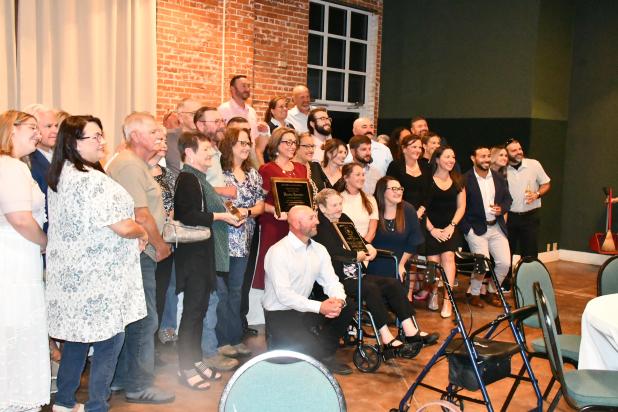
POLLOCK, La. — Twelve people who have had a lasting impact on 4-H, including two from Vermilion Parish have been honored as 4-H Hall of Famers.
Former Vermilion Parish Sheriff Mike Couvillon and Johnny Boudreaux, were among the 12 honorees inducted into the Louisiana 4-H Hall of Fame during a ceremony held Aug. 9 at the Grant Walker 4-H Educational Center in Pollock, Louisiana.
Tara Smith, LSU AgCenter executive associate vice president and director of the Louisiana Cooperative Extension Service, opened the ceremony noting that the work the inductees have done over the years has benefited generations of 4-H’ers and has help grow the organization to more 148,000 youth across the state.
“Thank you for the time, talent, money and energy you have put into the youth in 4-H,” Smith said.
]Retired Vermilion Parish sheriff Mike Couvillon attended 4-H camp as a child and hadn’t been back to Camp Grant Walker in decades.
“When I drove up, I recognized the most important building to me in 1963 — the dance hall,” Couvillion said. “Don’t ever change the dance hall.”
Couvillon has been a tireless advocate for Vermilion Parish 4-H throughout his 20 years of public service. A 4-H alumnus himself, Mike began supporting 4-H as a livestock buyer and project leader.
As sheriff, an office he held from 2004 to 2024, Couvillon deepened his impact—donating over $170,000 through livestock purchases, providing vans and deputy labor for transportation, and serving as an auctioneer for major fundraisers. His efforts helped raise over $40,000 for St. Jude through Junior Leader events.
A Master Horseman graduate, Couvillon also led horse clinics and supported the parish Shooting Sports program.
He was instrumental in launching the 4-H ATV Safety Program and consistently judged youth events. His belief in 4-H as a builder of leadership and character is matched by his actions. Whether mentoring youth, securing resources, or volunteering behind the scenes, Mike’s legacy is defined by service, generosity, and a deep commitment to making 4-H thrive in Vermilion Parish.
Boudreaux’s legacy in Vermilion Parish 4-H spans more than five decades of exceptional leadership and support.
A lifelong advocate for agriculture and youth, Boudreaux has served as a Livestock and Horse Project Leader for over 50 years and played a pivotal role in establishing the parish Extension office through the successful passage of a sales tax.
As a leader in organizations such as the Louisiana Rice Research Board and Farm Bureau, he used his influence to advance 4-H initiatives. He conducted horse clinics, served as a regional horse camp instructor, and mentored countless youth. His work with the Vermilion Parish Cattlemen’s Association includes sponsoring a 4-H scholarship, and he has been recognized with multiple awards for conservation, farming, and service.
Boudreaux said he believes 4-H builds character and instills lifelong values in youth. His behind-the-scenes leadership and enduring commitment to the program have shaped generations of 4-H leaders.
The 12 inductees are:
• Johnny Boudreaux, Vermilion Parish
• Rosy Williams Bromell, Lincoln Parish
• Mike Burns, Grant Parish
• Mike Couvillon, Vermilion Parish
• Clint Depew, 4-H State Office
• Raymond Latiolais, St. Martin Parish
• Amy Magee, Jackson Parish
• Judith Ann McKee, Caldwell Parish
• Staci Albritton Mitchell, Ouachita Parish
• Patsy Sonnier, Lafayette Parish
• Darlene Taylor, Cameron Parish
• Steve White, Calcasieu Parish

Article Image Alt Text

Vermilion Parish School district close to having balanced budget

Superintendent predicts the district to have a shortfall of $160,000

The news about the operating budget for the 2025-26 school year was mostly positive, as presented by Superintendent Tommy Byler. 
The school district operates with a budget of $93 million. During last week’s school board meeting, Byler forecasted that the budget would be only $160,000 under budget.
“Being $160,000 short of a $93 million budget isn’t bad,” said Byler. “I know other districts projected to be $2 million short.”
The school district has lost around 1,100 students over the last three years, resulting in a reduction of around 40 teachers, compared to three years ago.
Last year’s budget was just over $93 million, and Byler is predicting the number to be around $93 million again for this school year.
Byler said every department trimmed the fat and is operating on a streamlined budget. 
Despite the budget being almost balanced, school board members shared their vision for the future of education. With oil and gas revenue drying up because there are no oil or gas wells on property owned by the school district, and students leaving the public school system at a rapid pace, changes are going to have to be made, three board members said.
School Board member Dr. David Dupuis, who was once mayor of Gueydan, said, “We are going to have to make some tough decisions that are not going to be popular. But we are going to have to make them.”
School Board member Nick Touchet added, “We stopped a lot of bleeding this year. However, we know more is coming.”
Then the dreaded word that no one wants to hear was uttered by a school board member: “consolidation.”
School board member Kibbie Pillette discussed consolidating some schools to save money.
“We may have to look at consolidation,” said Pillette. “You listen to Mr. Byler’s report and hear the number of students who have left the school system,  which is a lot of students.  It is becoming increasingly difficult for the school district to create a balanced budget each year. 
“We are going to come to a point where the money we have is going to get tougher to operate the school system,” Pillette added. “Because of that, we are going to have to fix our school system to operate with the money we have. That may mean closing schools.”

Article Image Alt Text

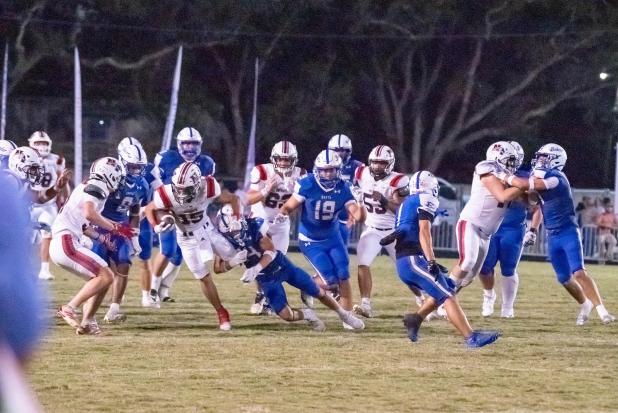
Abbeville defenders Deylon Joseph (5) and Jazavian Briggs (19) zero in on a Eunice runner for a loss of yards in Thursday’s jamboree.

Article Image Alt Text

Abbeville’s Andrew Payton III hangs on to a Eunice receiver for a tackle.

Eunice too much for Abbeville

CROWLEY — The Abbeville Wildcats dropped a 24-6 decision to the Eunice Bobcats Thursday night in the Acadia-Vermilion Parish Jamboree at Donald Gardner Memorial Stadium.
 Abbeville head coach Jonathan Zenon was not pleased with his team’s effort, especially compared to last week’s scrimmage against Comeaux, when the Wildcats produced more than 600 yards of offense.
“It was a horrible performance,” Zenon said.  “We came in on our high-horses and came out flat.  We have to do some more soul-searching to find the guys who truly want to play.  We have to find guys who aren’t afraid of the moment. We’ll go back to the drawing board.”
 Eunice took the opening kickoff and drove right down the field.  The touchdown and subsequent two-point conversion put the Bobcats ahead 8-0.  The Wildcats took over, and on their second play from scrimmage, turned the ball over.
The Eunice offense went right back to work, eating clock and methodically marching down the field.  The Wildcats forced two fourth downs on the drive, but the Bobcats managed to convert both en route to a 16-0 lead.  
 “On fourth and less than five, that’s an automatic hard count,” Zenon said.  “We jumped offside.  It was a significant moment that we didn’t fully understand.  We have to work on it.”
On the first play of its next drive, Abbeville turned the ball over again.  The Wildcats ended the first half with three plays, zero yards, and two turnovers.
Abbeville opened the second half with a 62-yard touchdown drive to pull within 16-6.  Quarterback Dazavien Maze connected with Braylon Himel from 34 yards out for a TD. The two point conversion play failed.
 Eunice answered with its third touchdown drive of the game.  On the drive, Justin Montgomery had two carries for 15 yards. The play that set up the touchdown was a 12-yard reception by Jacolby Campbell.
The two-point conversion made it 24-6.  The Wildcats were unable to get any closer.
  Maze completed seven passes for 89 yards and a touchdown.  Himel finished with four catches for 70 yards and a touchdown.  Jacolby Campbell had three catches for 19 yards.  Running back Justin Montgomery had 27 yards rushing on five carries.
 Abbeville will be on the road at Washington Marion in week one.  To come away with his first career win, Zenon said it will take everyone buying in.
 “We need our guys to 100 percent trust the process,” Zenon said.  “We can’t have guys going through the motions.  The best players at each position will play, whether they play both ways or not.  It may be only 15 guys instead of 22, but the best players are going to play.”
AHS defensive lineman Zalen Hopkins had two sacks.

Article Image Alt Text

NV's Avery Stutes catches the ball and runs 38 yards for a touchdown.

Article Image Alt Text

Gage Wise fights for rushing yards for North Vermilion.

North Vermilion scores 21 points for jamboree win

CROWLEY — The North Vermilion Patriots had an impressive first half, leading the Crowley Gents 21-0 at halftime. However, the second half saw some sloppiness in their play.
Despite this, the Patriots secured a 21-0 victory over the Gents on Thursday night in the second game of the Acadiana-Vermilion Parish Jamboree.
This Thursday, the Patriots will kick off the season with an away game against the Church Point Bears, who finished last year’s regular season with a 7-2 record.
NV head coach Roderick Moy stated that the coaching staff will focus on correcting the mistakes made in the second half during practice this week.
“We got sloppy in the second half,” said Moy. “We made too many mistakes. We are not good enough to shoot ourselves in the foot.  If we do not make mistakes, and be us, like we did in the first half, we are good. 
  “I thought we came out and played well in the first half. We were hungry and wanted to play better than we did last week against Mamou.
“We answered the bell this week because this is our last dress rehearsal.”
Things went the Patriots’ way in the first half. On an attempted punt,  the snap was bad, and Justin Romero alertly recovered a fumble.
On the Patriots’ first play after the fumble recovery, Kole Seibold had a 25-yard run that set up the Patriots’ first touchdown. Avery Stutes had two runs for 15 yards and then Gage Wise darted  17 yards for a touchdown with 8 minutes left in the first half.
Kicker Logan Blanchard nailed all three of his extra points in the first half.
The Patriots cashed in Crowley’s three special teams miscues for three touchdowns.
The Patriots regained possession after holding the Gents on four downs, and it would be another mishandling of the ball on a punt attempt by Crowley.  Jaiden Payne tackled the punter to prevent the kick.
Four plays later, then, Stutes trotted up the middle from 10 yards out to score NV’s second touchdown of the night that made it 14-0.
Crowley had another misfortune with special team’s play, and NV’s Tucker Faulk recovered a fumble, giving the Patriots the ball 38 yards from the end zone.
Stutes hauled in a 38-yard pass for a touchdown with 3:02 left before half time.
“We got better from last week to this week. Now we have to take the next step,” said Moy.
NV had 139 total yards. The Patriots rushed for 101 yards.
Leading the Patriots’ rushing was Avery Stutes, who had seven carries for 32 yards. He also scored a running touchdown and a 38-yard reception touchdown.
Gage Wise had four carries for 30 and quarterback Eli Dubois rushed for 16 yards on four carries.

Article Image Alt Text

Delcambre quarterback Lynkon Delcambre

Delcambre airs it out in jamboree win

DELCAMBRE — The Delcambre Panthers cruised to a 23-0 win over Highland Baptist in the Iberia Parish Jamboree on Thursday.
Backup quarterback Lynkon Delcambre had a big night throwing the football.
He completed five out of six passes for 169 yards and he threw two touchdowns.
Tre Leleux had three of the five catches for 76 yards and a touchdown.
Tucker Zagar had two receptions for 93 yards and a touchdown.
The Panthers did run the football. Hugo Morales had three carries for 15 yards and Nave Nguyen had four carries for 22 yards and a TD.

Pages

Vermilion Today

Abbeville Meridional

318 N. Main St.
Abbeville, LA 70510
Phone: 337-893-4223
Fax: 337-898-9022

The Kaplan Herald

219 North Cushing Avenue
Kaplan, LA 70548